
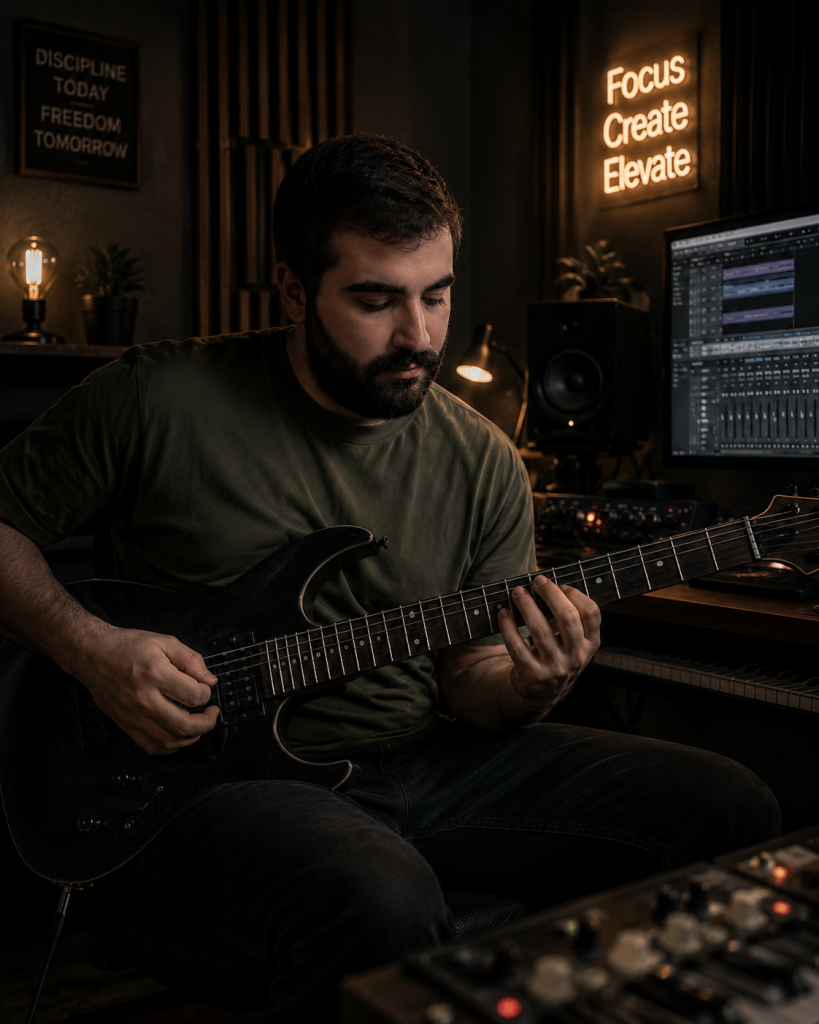
Malta-based composer and musician Serag Baddar has returned to an idea he believed in long before he knew how to finish it. The seed was a guitar riff he wrote at 15. Fifteen years later, with life, experience and musicianship finally catching up to the sound he had imagined, that riff has become “Limerence,” an intimate, atmospheric post-rock piece shaped by clean guitars, patient rhythms and the lingering ache of a feeling that never fully disappeared.
Originally titled “Lotus,” the track carries a small but deliberate connection to Buckethead’s “Padmasana,” whose rhythm guitar influenced one section of the composition. Its wider musical language, though, comes from Baddar’s fascination with the quieter spaces inside progressive metal. Deeply influenced by Opeth and Tool, he found himself drawn to the clean, spacious passages that interrupt heavier music. “Limerence” grows from the question of what might happen if those passages became the whole environment.
The song moves at an unhurried pace, giving its central guitar melody room to settle into the arrangement. Crisp, clean guitar tones fold into delicate atmospheric textures, while soft vocals shimmer beneath the surface instead of pulling focus. The melancholy is restrained. It feels closer to the weight of remembering something years later than to the immediacy of heartbreak itself.
One of the track’s strengths is how little it needs to communicate that feeling. There are no elaborate rhythmic gymnastics and no walls of distortion. Baddar trusts melody, space and the interaction between parts. The guitars and bass move along separate lines, each maintaining its own shape before converging around the song’s central hook. In the final section, he pushes that idea further by isolating the three instrumental parts, then drawing them together again. The arrangement briefly exposes its own architecture, and that revelation becomes the outro.
The track’s “demo” presentation adds to its intimacy. Baddar resists polishing away every rough edge, leaving enough rawness to preserve the sense of an idea captured close to its natural state. That choice reflects his philosophy of “writing for dopamine,” creating because the act itself provides the reward.
Baddar approaches music by following instinct rather than chasing a particular sound, market or genre. He describes himself as a philosopher who happens to make music, and “Limerence” suits that outlook. The piece feels reflective and carefully considered, yet it never turns clinical or overly self-conscious. Its emotion remains measured throughout.
A teenage riff has finally arrived at the form it was waiting for. That may be the most affecting part of “Limerence.” It feels like a musician meeting the person who first wrote the idea fifteen years earlier, then finally completing the song they began together.
How about that! Enjoy “Limerence” here and share it with your mutuals.
Follow Serag Baddar: Instagram