
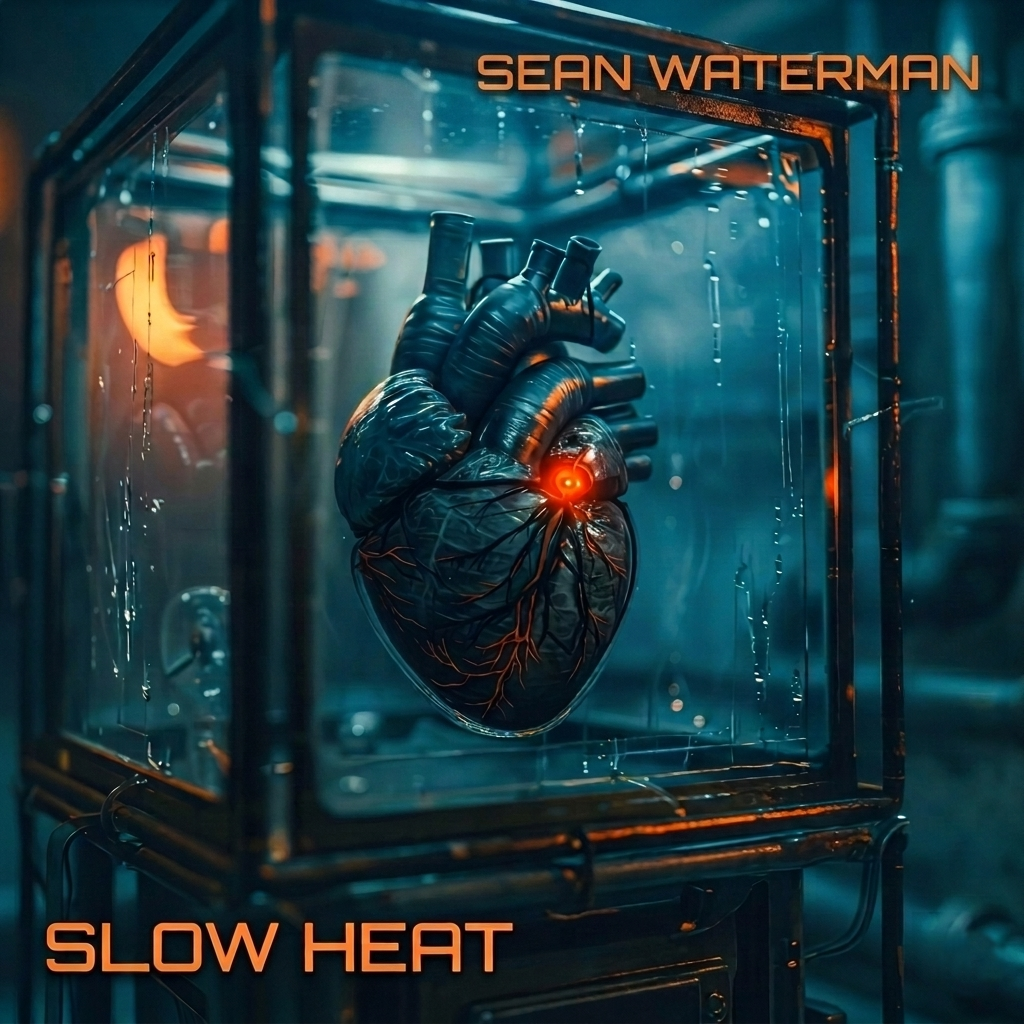
Growth in an artist’s catalog rarely comes from severing ties with the past. The most convincing evolution often happens when an artist finds a new language for instincts that were already there. Sean Waterman’s “Slow Heat” works on that level. It does not sound like an attempt to outrun his earlier work. Instead, it suggests an artist realizing how far those foundations can stretch.
Released in June 2021, Waterman’s Devices established a guitar-driven chapter in his artistic identity. Songs such as “Rules” and “Zero Hour” showed the emotional force of his alternative-rock approach and helped define the ground he has since built on. “Slow Heat” keeps that foundation in view while rearranging its materials.
The change is clear from the start. Devices often channeled Waterman’s emotional intensity through guitar-driven urgency. “Slow Heat” moves that same pressure into a more atmospheric alt-R&B setting. Clean electric guitar remains present, surrounded by warm synth bass, restrained percussion, spacious production and dreamy vocal textures. The track feels smoother, darker and more cinematic, yet the emotional directness at the center of Waterman’s songwriting remains intact.
That matters because genre shifts can easily become cosmetic. Change the drums, add synths, soften the edges, and experimentation can amount to little more than surface treatment. Waterman’s move feels more substantial because the sound alters the way the emotion is presented. On “Slow Heat,” he discovers that tension can live in patience, space and groove instead of depending on the rock vocabulary that carried it before.
His background makes the transition feel especially natural. Born in Brooklyn and shaped by the Southern music scene, Waterman has long occupied an intersection of musical traditions. His work draws from organic acoustic songcraft, alternative-rock grit and foundational R&B instincts. “Slow Heat” brings those strands together in a way that lets each retain its character.
The clean guitar preserves some of the organic quality associated with his earlier work, while the heavy, soulful groove reaches toward his R&B foundation. Atmospheric synths widen the frame, creating an art-noir environment that feels contemporary and less bound to conventional rock structure. Waterman does not force these influences into competition. He gives them enough room to sit alongside one another.
Prince is a relevant point of reference here. “Slow Heat” avoids imitation. Its arrangement instead reflects a similar openness to treating genre as a palette rather than a fixed boundary. The spacious vocals, the exchange between guitar and synth, and the willingness to leave air in the track give Waterman room to approach modern pop and rock without being boxed in by either style.
Crucially, the evolution does not feel driven by novelty. The song’s emotional subject remains closely tied to concerns that have shaped Waterman’s work. “Slow Heat” centers on conflict, specifically the effort to stay at peace while old habits repeatedly disturb that peace. The intensity has not disappeared. Waterman has changed the means through which it reaches the listener.
For that reason, “Slow Heat” feels like a continuation of Devices rather than a rejection of it. “Rules” and “Zero Hour” showed how guitar-driven music could carry Waterman’s emotional urgency. Here, atmosphere, groove and restraint create a comparable tension through different means.
There is confidence in that transition. Waterman does not seem to be chasing a genre because it is fashionable. He is widening the vocabulary available to his songwriting. His music can move through alternative rock grit, soulful R&B grooves, modern pop sensibilities and cinematic atmospheric production without making those elements feel pasted together.
That flexibility is what gives “Slow Heat” its significance within his catalog. Devices was a launching point, not a conclusion. The new single presents Waterman as increasingly comfortable in the space between genres and increasingly assured in shaping that space around his own instincts.
The sound that established him is still audible, now bent into a different form. In “Slow Heat,” that adaptability becomes one of the clearest signs yet that his artistic identity is continuing to expand.
Connect with Sean Waterman